CATM — Closed Analogies Version (CATM-CL)
The original CATM test assesses children's cognitive modifiability, learning strategies, high-order concepts and operations, accessibility to mediation, and various cognitive and motivational functions used to solve problems. The principal required operation is analogy — a robust operation used in various problem-solving activities and academic achievements.
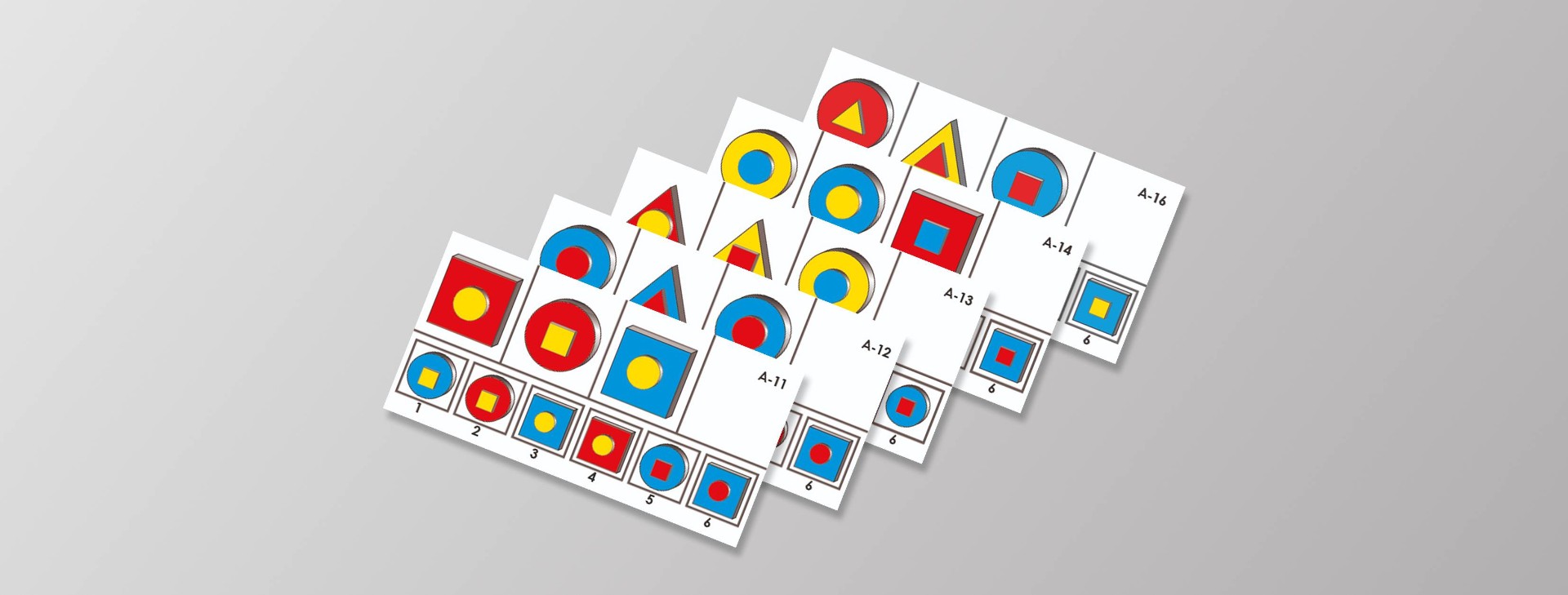
The original CATM comprises classical analogies in A : B :: C : D form. The child is presented with a pile of tangible blocks in three colors, three shapes, and two sizes. The examiner places three blocks in front of the child and asks the child to complete the last block by selecting it from the pile.
The CATM-CL differs in two ways
- Problems are presented in a three-dimensional mode on a card.
- At the bottom of each problem there are six possible solutions — one correct, five distractors. The child must sort out irrelevant interfering distractors while containing the correct answer in working memory.
Cronbach-alpha reliability coefficients on a sample of Grade 1 children (n = 252) were .64 for pre-teaching and .78 for post-teaching. In a study on the effects of training working memory on Readiness for Math among young children (n = 145), the CATM-CL was a significant predictor of Readiness for Math.