Working Memory Tests for Young Children (CSWM & CVWM)
Working memory (WM) is a central psychological construct often perceived as a domain-free factor. Evidence indicates that WM is crucial in various educational activities — from language skills to comprehension to mathematical reasoning. In virtually all complex cognitive activities, WM is activated into fluid intelligence.
WM is an active memory system for temporary maintenance and simultaneous information processing (Baddeley, 2012). It enables the retention of information for a limited time, allowing individuals to engage in continuing cognitive activities. WM has been related to fluid intelligence and academic achievement, and research has shown that it comprises distinguishable interacting mechanisms that afford a flexible mental workspace for maintaining and transforming information.
Children's Spatial Working-Memory (CSWM) Test
The CSWM was initially designed for young children aged 5–8 years. In creating the CSWM, we sought to overcome the complexity difficulty by better matching the tasks' complexity to the developmental stage of young children and by introducing a new structural design that implicitly calls attention to embedded spatial cues that facilitate visuospatial processing.
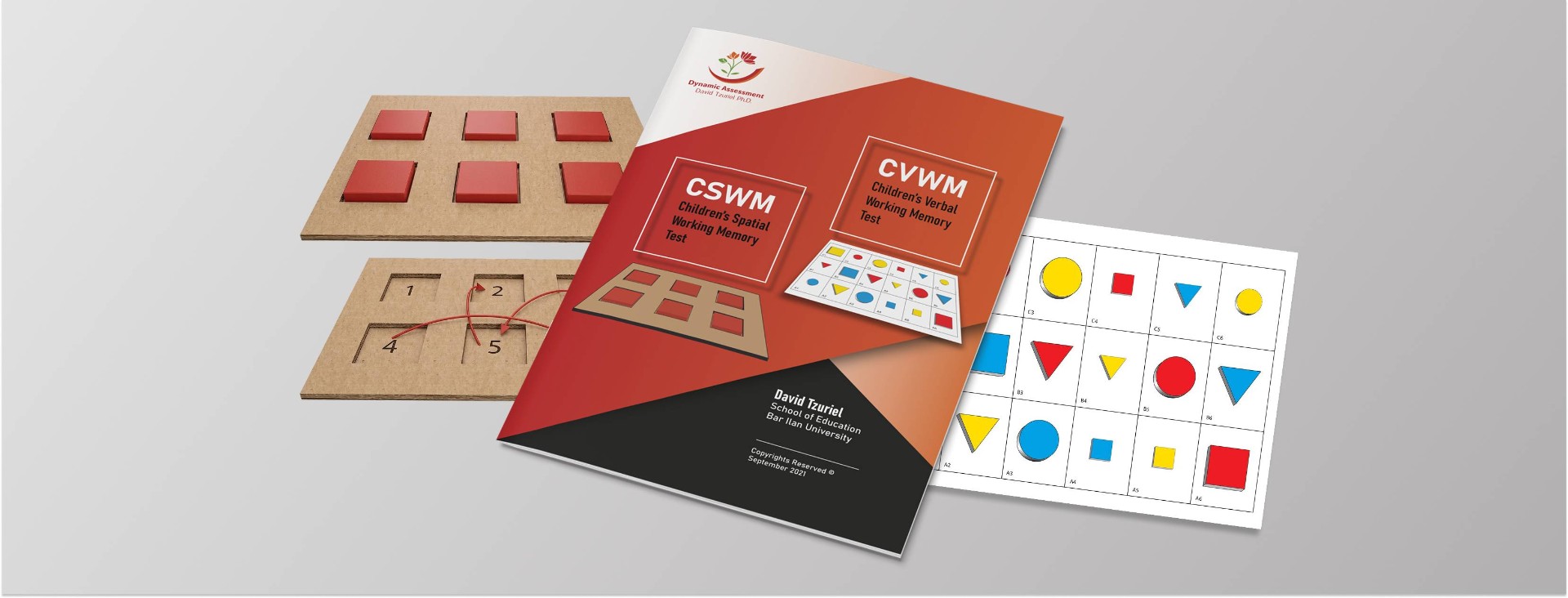
The CSWM comprises a plate with 6 'Windows' arranged in two rows, one beneath the other. The examiner points to 'Windows' in a specific sequence and asks the child to repeat the sequence precisely. The test includes seven levels of four trials each; in each level, the examiner points to several windows (increasing from 1 to 7) of different spatial arrays, increasing the difficulty of the spatial memory task with successive trials.
The reliability and validity of the CSWM were examined in several studies on kindergarten to Grade 4 students. The CSWM correlates significantly with the Knox Cube Test (r = .48, p < .01), the Mental Rotations subtest of the CMB (r = .55, p < .001), the CVWM (r = .34, p < .01), the Backward Digit Recall test (r = .46, p < .01), the Understanding of Directions test (r = .49, p < .01), the Head-Toes-Knees-Shoulders test (r = .44, p < .01), and the CATM (r = .27, p < .01).
Children's Verbal Working Memory (CVWM) Test
The CVWM aims to test verbal WM by following verbal instructions to point to a figure or a sequence of figures presented in a matrix of geometric shapes. It comprises two stages: Preliminary and Testing.
The preliminary stage familiarizes children with the three main concepts of the test (color, shape, size) and with essential verbal tools necessary to process the instructions ('to the left/right of,' 'above/under,' 'in-between'). The child is presented with nine figures of different shapes and colors and asked to point in a series of nine questions on the figures. This ensures that WM performance does not derive from a lack of familiarity with position concepts.
In the testing stage, the child is presented with a matrix of eighteen figures arranged in a mixed 3 × 6 array. The figures vary in shape (square, triangle, circle), size (big, small), and color (red, yellow, blue). In each item, children are instructed to point to a specific figure using two or more descriptors (e.g., 'Point to the shape under the big red circle and next to the small blue square'). The instructions require activation of WM by using all verbal components and integrating its various dimensions. The testing stage comprises ten instructions increasing in complexity, with more complex items requiring negation (e.g., 'Show me the circle that is not next to the blue triangle').
Cronbach-alpha reliability coefficients for the pre- and post-intervention tests are .78 and .77, respectively.