Children's Conceptual and Perceptual Analogical Modifiability (CCPAM)
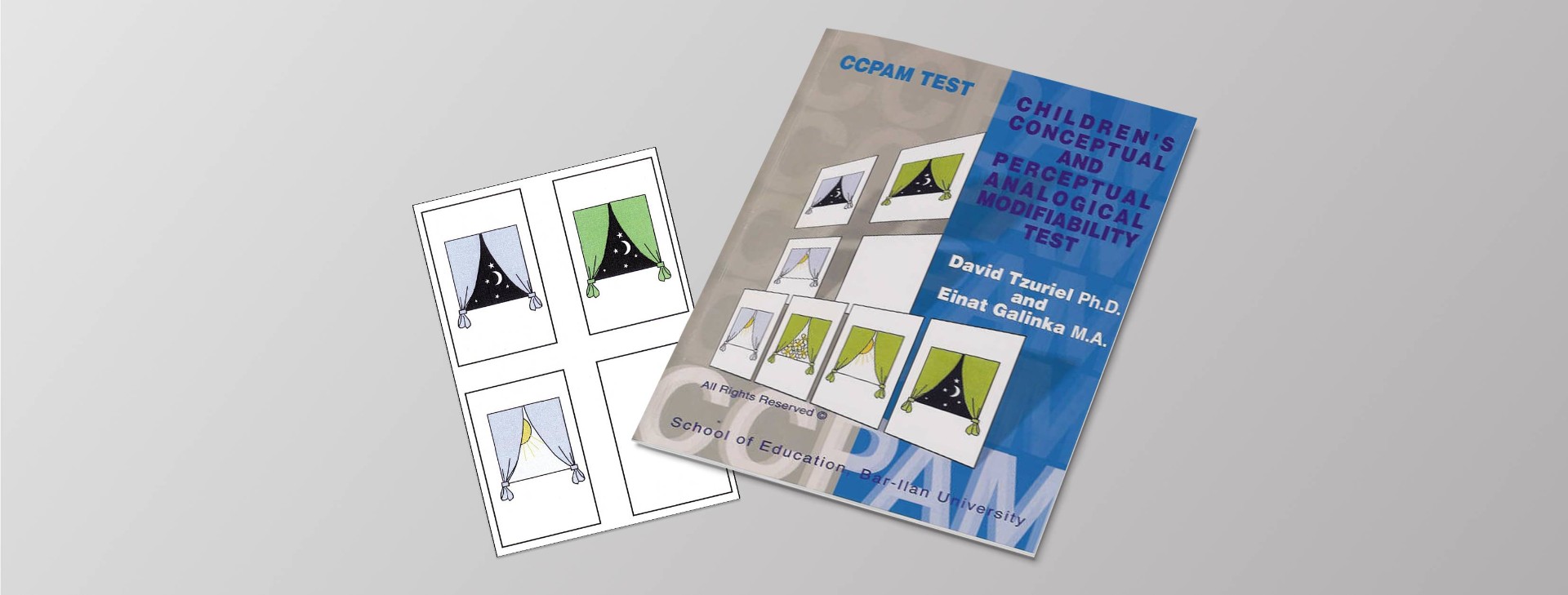
The CCPAM is composed of two versions: Closed and Construction Analogies. Each version comprises two sets of analogical problems — conceptual and perceptual. The test is designed for 3–5 year old children.
Each closed analogy is formatted in a 2 × 2 matrix (A : B :: C : D) and presented in a pictorial colored modality. At the bottom of the page there are four alternative answers, only one of which is correct.
In construction analogies, each problem is presented with 6 cards in mixed order, and the child is asked to build an analogy using only four cards arranged in a 2 × 2 pattern, sorting out two distractive cards.
Research findings with 5-year-old children showed that perceptual training helped improve only perceptual analogies, while conceptual training improved both conceptual and perceptual analogies.
CCPAM analogies were associated with emergent literacy and with improved analogical reasoning in children with intellectual disability.