The Mental Rotation 3-Dimensions (MR3D) Test
Mental rotation (MR) refers to the ability to imagine how an object seen from one perspective would look if it were rotated in space into a new orientation and viewed from a new perspective. The MR of 3-dimensions is a part of spatial ability skills and is considered the most neglected skill in education despite its importance for life skills such as medicine, architecture, navigation, surgery, and engineering.
Spatial abilities are essential when giving directions, assembling furniture, packing objects in a car, and solving academic tasks such as reading, mathematics, and geometry. MR skills are also relevant to STEM disciplines — important for careers in architecture, engineering, navigation, geography, chemistry, biology, and medicine.
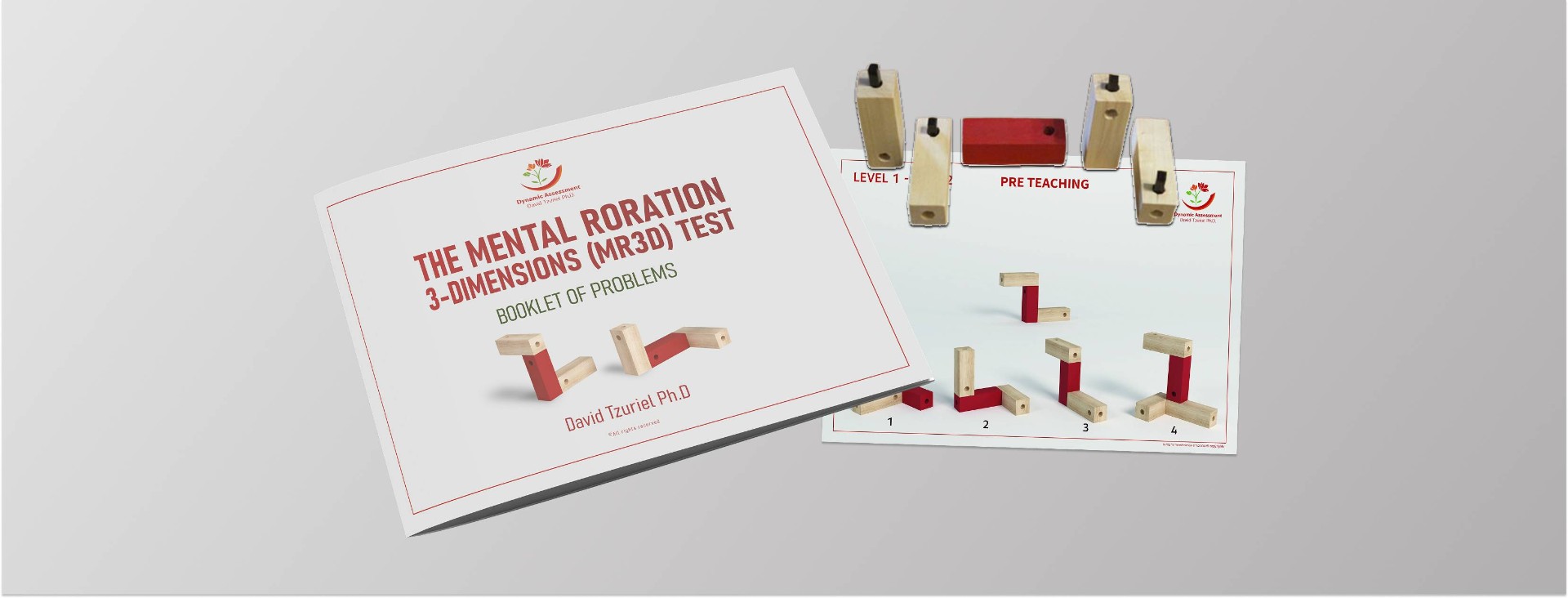
The MR3D test is a dynamic assessment (DA) instrument aimed at assessing the cognitive modifiability of young children (5–8 years old) and older children with learning disabilities. It comprises three phases: Pre-Teaching, Teaching, and Post-Teaching. Each phase has 16 complex problems divided into Level I and Level II. In each problem, the child is presented with a 3D pattern of a target 3D object composed of rectangular blocks and four 3D objects at the bottom of the page — three distractors and one identical to the target object but rotated. The child is asked to point to the correct object.
The teaching phase is conducted with tangible blocks. The child is mediated to identify differences in 3D patterns and learn strategies for constructing 3D patterns, by motoric construction of a tangible 3D pattern identical to a 3D pictorial pattern and comparison to the same pattern presented in a different orientation.
The validity and reliability of the MR3D were established in several studies — Cronbach-alpha reliability coefficients ranged between .73 and .82 for pre- and post-teaching scores. A short mediation of 30–40 minutes significantly improved children's performance on near-transfer MR3D tasks and on far-transfer skills of spatial ability, map reading, geometry, and math ability — especially for children with learning disabilities.